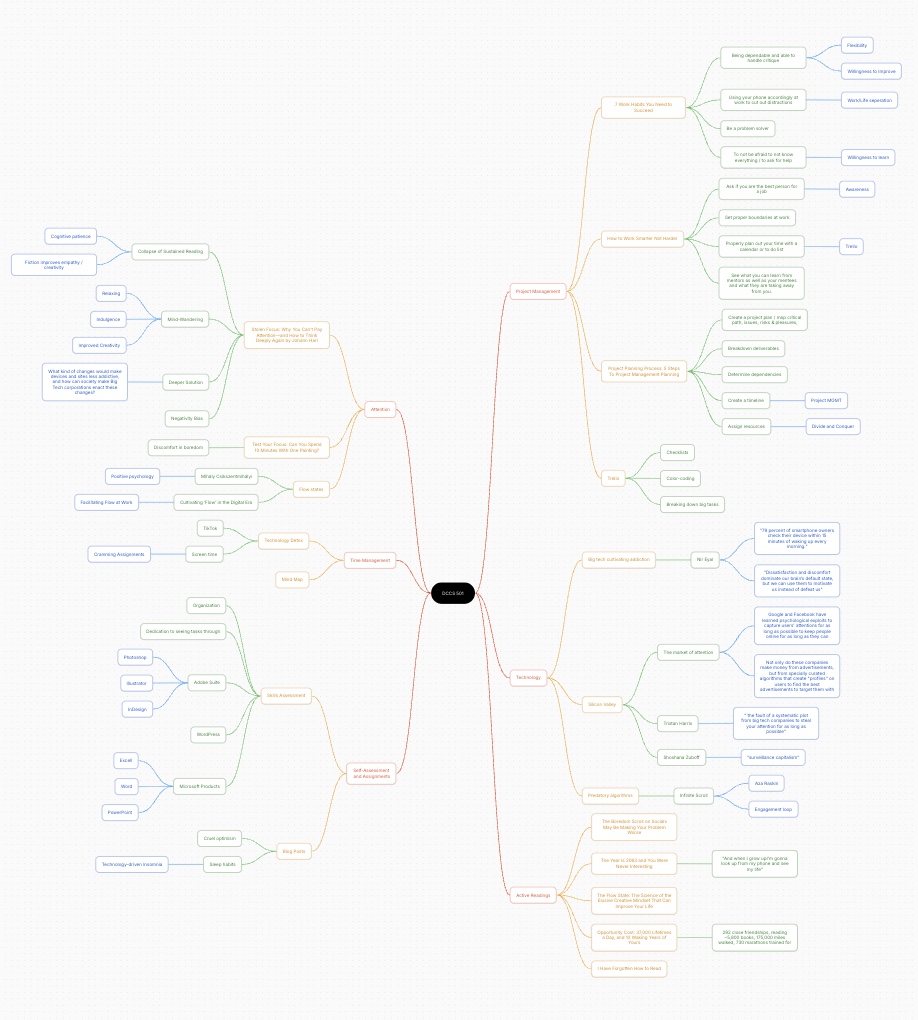
When asked to describe my general demeanor and my resting face, the answer from my friends has always been the same: “You always look like you’re trying to balance thinking about four topics at one”. This bluntly honest assessment couldn’t be closer to the truth. My mind is always racing a million miles per minute, trying to wrangle several stressful thought processes at once. So, when I was assigned to create a Mind Map of everything I had learned so far in my graduate studies class, I was wary to say the least.
I had learned so much in the past five weeks in this course, and trying to compile all my brainstorming ideas and thoughts onto one simplified document felt nearly impossible. As I read more about what mind maps do, it eased my fears a bit. Mind maps are meant to streamline getting thoughts & ideas out of your head and onto paper in a simplified, visual way. According to mindmapping.com, all mind maps share common characteristics: “They have a natural organizational structure that radiates from the center, using lines, symbols, words, colors, and images based on brain-friendly concepts. Mind mapping transforms long, monotonous lists into colorful, memorable, and highly organized diagrams that align with your brain’s natural way of processing information”.
As a hobby artist and photographer, the idea of corralling my racing thoughts into a simple, visual diagram sounded appealing. But when I jumped into making my very own mind map on mindmup.com, I immediately felt overwhelmed. All that stared back at me was an entirely blank canvas, asking me to start when I was ready. The only tutorial was for keyboard shortcuts, and that was it: I was completely on my own, with my thoughts still swirling uncontrollably in my head. Even after putting down the root topic and six core ideas, I felt lost. My fears from before came flooding back, and the task now seemed impossible. I frustratedly closed my laptop and did everything in my power to avoid the mind map: like rewatching avatar: the last airbender, chipping away at busywork for WQAQ, and more.
After taking some time away from the mind map, I returned a bit calmer than before. I slowly started stringing together my thoughts and research, watching the mind map grow in the process. The more I wrote, the easier the task became, and I found myself in a rhythm of thought (or a micro flow state, if you will). My mind map grew further and further as my thoughts became more organized. When I finally felt finished and took a step back to admire my work, I was shocked. A seemingly impossible task had been complete, and was now sprawling across the canvas. All the work I had done in the past month and a half had been contained in a pleasant, easy to read format. Not to toot my own horn, but I think it turned out great. If you’re interested in seeing my completed mind map, check out this link.




Leave a comment