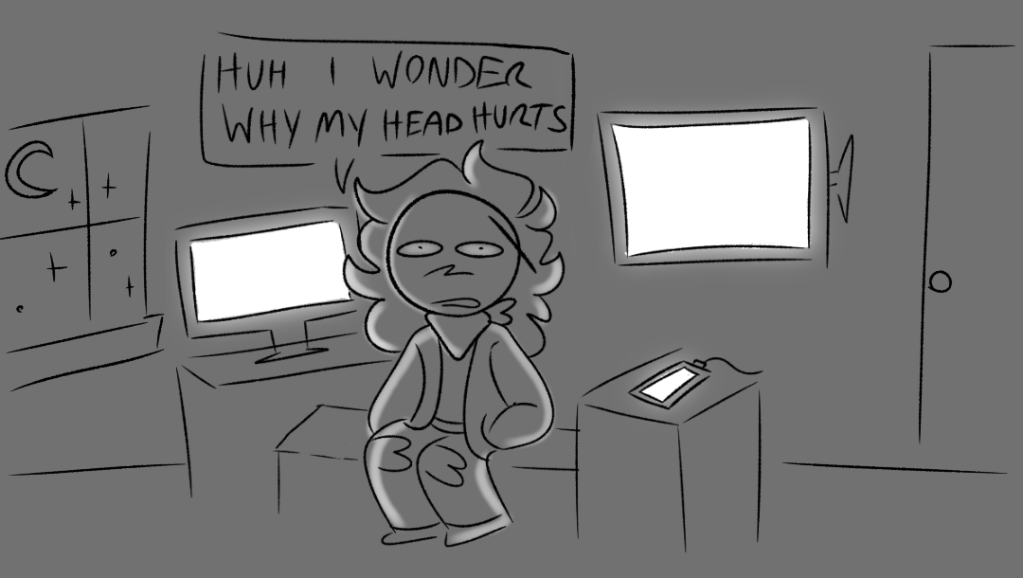
For as long as I can remember, I have always been the last in my household to go to sleep. My parents typically retire to bed on the earlier side, at around 9:00 P.M. (10:00 at the latest on the weekends), with my twin sister and younger brother following shortly behind them. As the last of my family heads upstairs to their bedrooms, my day (or rather, my night) has just begun. For the next four to five hours, the majority of the house is mine to do whatever I want without any interruptions. How do I choose to use this time? By endlessly scrolling on my phone, playing overstimulating video games on my laptop, and struggling to focus on an hours worth of television all at once, of course. By the time I finally decide to call it for the night, I have to account for the extra hour of restless tossing and turning before I drift into sleep, which is usually influenced by a double dose of store brand Melatonin. This routine has gone unchanged if not worse since I got to college, and has only been normalized by my fellow insomniac peers who finish assignments and go out partying until the wee hours of the night.
I’ve been content with this loop for a long time and have viewed it as a normal, uncontrollable aspect of my life. It wasn’t until I started reading Stolen Focus: Why You Can’t Pay Attention—and How to Think Deeply Again by Johann Hari that I realized how detrimental my nightly routine has been to my ability to focus. In Chapter Three (Cause Three: The Rise of Physical and Mental Exhaustion), Hari shares research from young scientist Charles Czeisler that connects lack of sleep to the deterioration of cognitive function in extreme ways. To be completely honest, reading about how just one or two poor nights of sleep can give you the same attention span as someone who is legally drunk terrified me. If only a handful of crappy nights of sleep could do that to someone, then what does nearly a decade of all nighters mean for me? As the chapter went on, it felt like my entire lifestyle was being flipped on its head and deemed as wrong. Suddenly, my store brand double dose of Melatonin was no longer my ally, but a direct cause of artificial, unfulfilling sleep.
After finishing this chapter of Stolen Focus at 12:30 A.M. on a weekday, I put my attention span to the test with the New York Times’ “Test Your Focus: Can You Spend 10 Minutes with One Painting?” interactive experiment, and the results were concerning. Sure, I was able to make it through all ten minutes of staring at one singular painting, but it felt like hell on earth. Even though I was still technically staring at a screen, I couldn’t supplement my boredom with TikTok scrolling or browser games. My discomfort with sitting in silence in the middle of the night with nothing but an objectively bland painting (Nocturne: Blue and Silver – Chelsea by James McNeill Whistler to be specific) opened my eyes to just how fried my attention span had truly become as a direct result of my nightly routine. In a panic, I kept searching further for people who were just like me and how they are trying to break the cycle of induced insomnia.
Right before my exhaustion finally caught up with me, at around 1 AM, I found “Stuck in the Scroll” by professor Ben Grosser, and it solidified my desire to change. Not only did I find someone who was publically sharing their TikTok compulsions, but the number of hours spent on TikTok was the same as, if not lower, than mine. As the grey “Is Ben scrolling TikTok right now?” screen stared at me, illuminating my bedroom, I decided right then and there that I needed to change.
Finally retiring to bed at around 2 AM, as I had done since I was in middle school, I told myself that something has got to give. Even if it starts with silencing hiding my phone in my nightstand before bed, or throwing out that deceitful bottle of Melatonin, I had to make a change before my attention span was unsalvageable. As I write this now, I can proudly say I haven’t taken any sleep aids since my spiral after reading Stolen Focus. Sure, I still spend hours and hours on my phone and laptop, but it’s baby steps.



Leave a Reply